
How to Choose the Right Wireless Tour Guide System
How to Choose the Right Wireless Tour Guide System
Choosing a wireless tour guide system may seem simple.
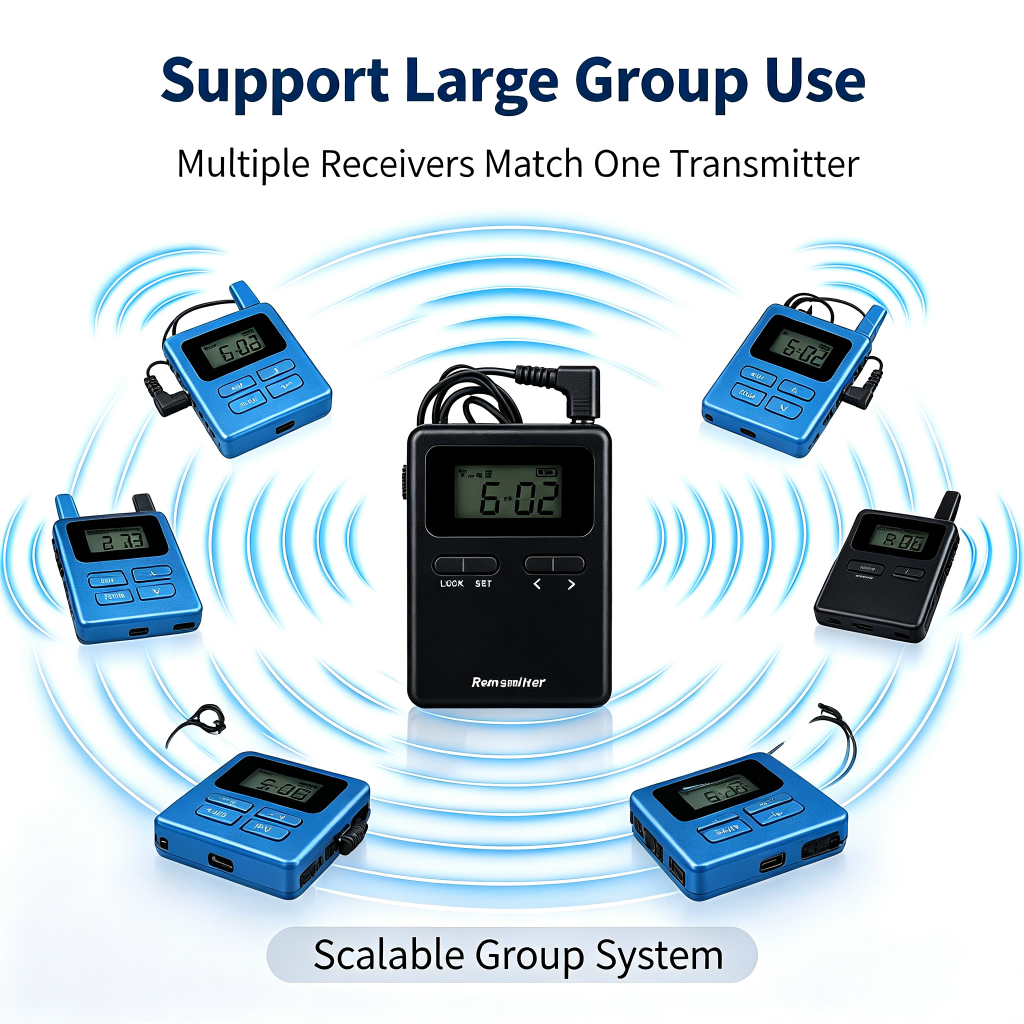
One transmitter sends audio, and multiple receivers receive it.
However, different applications have very different requirements.
A system designed for a small museum tour may not be ideal for a noisy factory or a large outdoor attraction.
Before purchasing equipment, organizations should evaluate several important factors.
1. Where Will the System Be Used?
The operating environment should be the first consideration.
Indoor Applications
Examples include:
- Museums
- Galleries
- Corporate offices
- Exhibition centers
- Universities
These environments may require compact equipment and controlled communication.
Outdoor Applications
Examples include:
- Tourist attractions
- Theme parks
- Historical sites
- Outdoor exhibitions
Outdoor environments may require longer transmission distances and stable performance.
Industrial Applications
Factories and production facilities may require strong communication performance in noisy environments.
2. How Large Is the Group?
A small group of ten visitors has different requirements from a group of one hundred.
Buyers should consider:
- Average group size
- Maximum group size
- Number of simultaneous groups
- Future expansion requirements
Choosing a scalable system can reduce the need to replace equipment as the organization grows.
3. How Long Will the Equipment Be Used?
Battery life is extremely important.
A short museum tour may last one hour.
A factory visit may include a presentation, lunch, production tour, and business meeting lasting an entire day.
Rechargeable systems can simplify equipment management and reduce the need for disposable batteries.
4. Does the System Need Multiple Channels?
Multiple channels can be useful when several groups operate in the same location.
They can also support interpretation applications.
Before purchasing, organizations should estimate the number of simultaneous communication channels required.
5. Is Ease of Use Important?
For public tours, the answer is almost always yes.
Participants may include:
- Children
- Elderly visitors
- International customers
- First-time users
Simple controls can significantly improve the user experience.
6. Consider Charging and Storage
Large numbers of receivers can become difficult to manage.
Charging cases or multi-device charging stations can help staff organize equipment efficiently.
This is particularly useful for museums, tour companies, and factories that operate tours every day.
7. Consider Hygiene and Earphone Management
Organizations should also develop a plan for:
- Cleaning reusable equipment
- Providing disposable earphones
- Storing accessories
- Replacing damaged items
This operational detail can have a major impact on visitor satisfaction.
A Practical Selection Checklist
Before purchasing, ask:
- What is the typical group size?
- Will the system be used indoors or outdoors?
- Is the environment noisy?
- How many simultaneous groups are expected?
- Is interpretation required?
- How many hours of battery life are needed?
- Does the equipment need to be expanded later?
- How will the devices be charged and stored?
Conclusion
There is no single wireless tour guide system that is perfect for every application.
The best solution depends on the environment, group size, communication requirements, and operational workflow.
By understanding these factors before purchasing, organizations can select a system that provides better performance, easier management, and a more professional experience for both guides and visitors.
您好,这是一条评论。若需要审核、编辑或删除评论,请访问仪表盘的评论界面。评论者头像来自 Gravatar。